Khaireian
For Bernardo Vilar. Natively: γλος Γειριιυ · glos Gēriyu [glo̞s ge̞ːɾɪjʊ]
About the language
After years of conlanging for myself, the first request I got was what led me to develop Khaireian, ending in a project consistently developed by me and the customer, in which he would develop most of the history and culture of an island, Khaireia, while I would create the language and help him out with some maps. We later ended up agreeing on including Khaireian as an example language on my website and, in early October 2026, he provided the first testimonial for my homepage.
In-universe, Khaireian is spoken in the (not very large) island of Khaireia, somewhere between Cyprus and the Turkish/Syrian Mediterranean coast. The civilisation, though of Hellenic (specifically Ancient Macedonian) roots, still visible in its grammar and orthography, is heavily Persianised, so is their language's phonology and some lexicon. What makes Khaireian unique is how this blend of cultures ended in a language so rich.
How it sounds
Khaireian has a stable, straightforward phonology, even though highly deviant from most Hellenic languages.
Velar stops often palatalise before front vowels or word-finally, the rhotic is often trilled word-initially, and and fricatives are voiced before voiced consonants. In some rural dialects, the long mid vowels /eː/ and /oː/ may be realised as diphthongs, which can be of different qualities, ranging from /aɪ̯, aʊ̯/ in the South to /ʌj, ʌw/ in the Centre, though they're often monophthongs in urban and standard speech. Depending on the speaker, postalveolar consonants can sometimes be realised as retroflex or alveolopalatal.
Consonants
| Place / Manner | Labial | Alveolar | Postalveolar | Dorsal | Glottal |
|---|---|---|---|---|---|
| Nasal | m | n | — | — | — |
| Plosive or Affricate | p · b | t · d | t͡ʃ · d͡ʒ | k · g | — |
| Fricative | — | s · z | ʃ · ʒ | χ | h |
| Approximant | w | ɾ · l | — | — | — |
Vowels
| Height | Front | Back |
|---|---|---|
| Close | ɪ · iː | ʊ · uː |
| Mid | ɛ · eː | ɔ · oː |
| Open | æ | ɑ(ː) |
Structure & grammar
Word order
Khaireian word order is predominantly VSO, with adjectives and numerals coming after nouns. The verb goes mandatorily on the initial position of the sentence.
Morphology
Similarly to most Indo-European languages, Khaireian features a fusional typology with a nominative-accusative alignment. It is also mostly dependent-marking.
Nouns
Unlike most of my other projects, which either lack grammatical gender distinctions or use non-binary noun classes, Khaireian features a strict binary gender system, simplified from the Indo-European tripartite distinction. Nouns inflect in number (singular, dual, plural) and case (nominative, accusative, genitive, dative). A noun can, alongside its distinctive gender, belong to one of five declensions, each of those potentially having different inflections for the masculine and feminine.
Verbs
Khaireian verbs feature a rich, classical Indo-European paradigm, conjugating in tense-aspect, mood, voice, and subject agreement. This agreement regards person (1st, 2nd, and 3rd) and number (singular, dual, and plural), though the person distinction isn’t employed in the dual. There are four moods: the indicative, subjunctive, imperative, and optative; it is also notable that the indicative is the one with the most distinct tense-aspects (present, imperfect, perfect, pluperfect, future, future perfect, and aorist), while the other three are only compatible with the present, perfect, and aorist. The voice distinction is a simple active-passive split. Partial reduplication is widely used, especially in derivations, such as in “ktawā” (to take) to “kiktā” (to possess, to have, to own).
Coming soon
(Coming soon)
Coming soon
(Coming soon)
The written language
Khaireian uses a modified form of the Greek alphabet, featuring the digamma (Ϝ/ϝ) for the /w/ sound, and the rough breathing diacritic (῾). Unlike in Ancient Greek, the rough breathing can be placed on any part of the word, and its absence is never marked with a smooth breathing diacritic. The low long vowel is marked with a macron, the mid long vowels are represented as digraphs (αι, αυ), and the high long vowels are marked as different graphemes entirely, the ones used for low-mid long vowels in Ancient Greek (η, ω). Furthermore, though not in usual orthography, some linguistic transcription conventions include acute accents to mark stress, and use a breve on the letter iota (ῐ) to mark it as a semifinal or as just serving to palatalise a consonant.
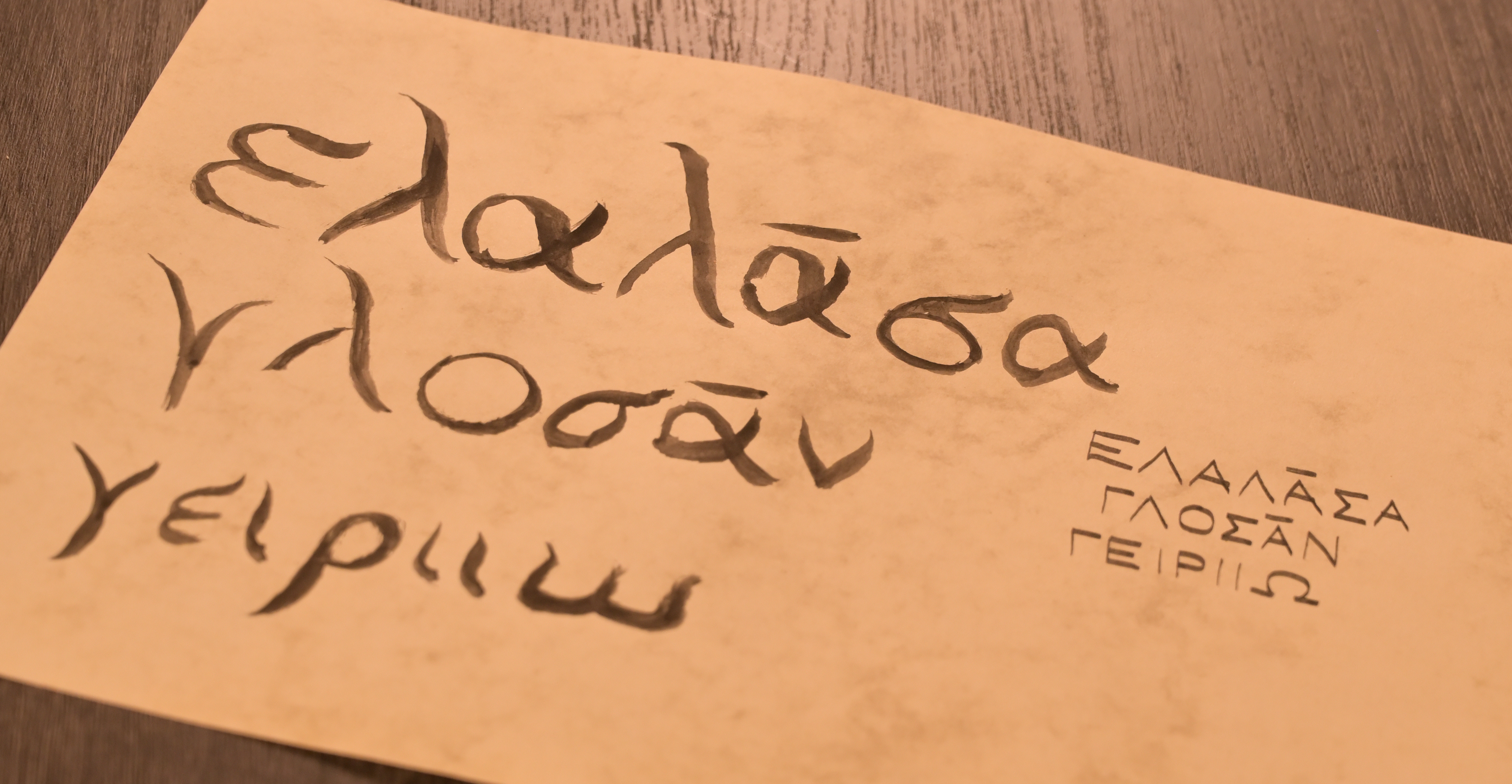
A taste of the language
look_at=1.PL.PRS.IND.ACT horizon=ACC.SG | burn=3.SG.PRS.IND.ACT 3.SG | argue=1.PL.PRS.IND.ACT REL possess=3.SG.PRS.IND.ACT who smoke=ACC.SG
A few words
Here are some words with no direct translation in English:
Let's build a language.
I create bespoke constructed languages tailored to fictional worlds, characters, cultures, games, films, and other creative projects.
Commission a language