Niyulira
Natively: niyulira [nʲʉlɪɾa(ʔ)]
About the language
In-universe, Niyulira is the most spoken language in Antichthon — a mysterious twin world hidden on the exact opposite side of the sun, originally seeded by ancient human civilisations lost to Earth's history. Millennia after the loss of the early stellar migration routes, the scattered colonies drifted into distinct epochs of isolation. Niyulira rose from this crucible as the dominant tongue and lingua franca of the Empire of Niyuvara, serving today as the primary vehicle of commerce, law, and high culture across the Empire and its surrounding states.
Niyulira is one of my few a priori languages, with a distinctively fluid yet melancholic aesthetic, while heavily inflected by an agglutinative morphology and an ergative-absolutive alignment. Its design philosophy combines structural symmetry with a culturally contextual lexicon, reflecting a society that values both scientific precision and poetic subtlety. Niyulira is distinctive for its phonotactic uniqueness, historically unmarked ergative, coindexation system, and focus-based case alternation.
How it sounds
Spoken aloud, Niyulira sounds balanced and oddly fluid, mostly avoiding harsh consonant clusters in favour of open syllables and a rhythmic, predictable cadence.
Historical phonological shifts led to a phonotactic system that prioritises word-initial consonant clusters and a simpler structure for the rest of each word. For example, “vrikirim” (verb (v.), to pardon) and vrugula (noun (n.), paper) follow this structure, with their only consonant clusters being word-initial. Word-medial consonant clusters are also possible, though rarer, such as in “gulitya” (n., book) and “masmiva” (n., ice). Word-final consonant clusters aren’t allowed by Niyulira’s phonotactics.
All historical occurrences of hiatuses were reduced to monophthongs or diphthongs, creating a distinction between “rivimalasa” (literally “strong vowels”, referring to those coming from historical hiatuses), and “dlumalasa” (”weak vowels”, those coming from historical vowels).
Niyulira has a regressive word-partial vowel harmony: vowels always change based on the one in the next syllable. This process affects both strong and weak vowels. It is doubtful whether vowels produced by this system are phonemically distinct or merely allophonic. First, Niyulira has only five orthographically distinct vowels, and native speakers process every vowel as either one of these vowels (for dlumalasa) or a combination (for rivimalasa). On the other hand, while ⫽u⫽ is realised as [ʉ] before a syllable containing ⫽i⫽, the same [ʉ] appears as a realisation of ⫽ui⫽ before ⫽u⫽, suggesting that [ʉ] might be becoming phonemic. A similar situation occurs with [ɛ], being both the realisation of ⫽a⫽ before ⫽i⫽ and of ⫽ai⫽ before ⫽u⫽. The vowel ⫽i⫽ is quite unique, since before ⫽u⫽ syllables it is either deleted or mid-centralised into [ə], depending on whether or not phonotactic rules will allow that to happen. Overall, the harmony appears to be partly phonemic and partly allophonic.
Word-finally, ⫽-Vm⫽ sequences, where ⫽V⫽ stands for any vowel, mostly became nasalised into /ã, ɪ̃, ʊ̃/, yet this isn't the case for most diphthongs. Word-finally, an optional glottal stop is introduced after vowels, except for most diphthongs and for nasal vowels. This glottal stop ceases to be optional whenever the first sound of the next word is a vowel.
Sibilants are pronounced slightly differently from English, with /s/ and /z/ realised as retracted alveolar fricatives ([s̠] and [z̠], respectively), except before /l/ and /ɾ/, where they are instead laminal ([s̻] and [z̻]). The consonant /ɾ/ can be realised as voiceless word-initially, as [ɾ̥], and as a voiceless trill [r̥] both word-finally and before voiceless consonants, the same positions in which /l/ is realised as a fricative, [ɬ]. Consonants are palatalised when followed by ⫽i⫽, and strings of any consonant plus /j/ also become palatalised consonants, all represented in the International Phonetic Alphabet (IPA) with [ʲ], though palatalised consonants aren’t represented in the table below. Some irregularities arise when it comes to palatalisation, such as /kj/ > [c], /gj/ > [ɟ], /ŋj/ > [ɲ], /θj/ > [s̠ʲ], and /vj/ > [vʲʝ].
Niyulira neither has a fixed stress system nor any type of tonal inventory. Besides, its prosodic intonation is largely absent, since the expressiveness of interrogations, exclamations, and sarcasm is already encoded in grammatical clitics, reducing the need for a prosodic system. Therefore, Niyulira often sounds quite melancholic and introspective.
Consonants
| Manner / Place | Bilabial | Labiodental | Dental | Alveolar | Palatal | Velar |
|---|---|---|---|---|---|---|
| Nasal | m | — | — | n | — | ŋ |
| Plosive | — | — | — | t · d | — | k · g |
| Fricative | — | v | θ | s · z | — | — |
| Liquid | — | — | — | ɾ · l | j | — |
Weak Vowels (Dlumalasa)
| Height / Backness | Front | Central | Back |
|---|---|---|---|
| Close | i · (ɪ) · ɪ̃ | (ʉ) | u · (ʊ) · ʊ̃ |
| Close-Mid | ie̯ | (ə) | uo̯ |
| Open(-mid) | (ɛ) | a · ã | (ɔ) |
Strong Vowels (Rivimalasa)
| Height / Backness | Front | Central | Back |
|---|---|---|---|
| Close | — | (ʉ) | — |
| Diphthong | (ɛj) | ʉj | (ɔj) |
| Open(-mid) | (ɛ) · ɛː | — | ɔː |
Structure & grammar
Word order
Mainly SVO, but interchangeable with other orders for poetic registers. Adjectives, determiners, genitives, and numerals are generally placed after the noun they modify, while prepositions are used rather than postpositions.
Morphology
Mainly agglutinative, with a few irregularities in the way morphemes interact with each other, though they can induce large changes in vowels due to the vowel harmony system. Morphosyntactically, Niyulira has an ergative-absolutive alignment with no agreement between verbs and their arguments.
Nouns
Nouns inflect by case, number, possession, register, and coindexation. Although historically the ergative was unmarked, in modern Niyulira, a word can never be left unmarked, mandatorily taking at least one of five case/number endings, such as -a (ergative singular or plural), -im (absolutive singular), -am (absolutive plural), -i/-yu (genitive singular), and -ya (genitive plural).
A noun can also be in the possessed state (marking it as possessed by another noun), the absolute state (unmarked, conveying that it is unpossessed), or one of six pronominal possession suffixes.
The remaining categories are register and coindexation, the former referring to the possibility of adding a clitic prefix, au-/av-, to show humility and/or more respect towards the noun, and the latter referring to a more complex system. Coindexation refers to a suffix, -lar/-lyar, that marks a noun as referring to an entity mentioned before.
Verbs
Verbs conjugate by tense, aspect, experientiality, voice, and polarity.
As in many other Lyro-Vateotic languages, the past tense is formed by a system of ablaut. The future tense, however, is formed by the verb stem being suffixed to another verbal stem “ar-” (or “ag-” for the negative and interrogative forms), and that “ar-” is the one to be conjugated (except in negative forms).
The aspects are the (unmarked) punctual, conveying actions done once; the habitual, for actions that recur regularly; and the intermittent, for actions that recur in an irregular, usually unpredictable frequency, though this last can also be used to convey some kind of aorist.
Experientiality (not to be confused with evidentiality, a concept that isn’t present in Niyulira) refers to whether or not the subject of the sentence or (with impersonal verbs) the speaker or entity in focus has experienced the event the verb conveys.
There are two voices in Niyulira: the active and the passive, the former being unmarked.
Finally, polarity refers to whether or not the action does happen (positive and negative), and encompasses the interrogative conjugations (which are only compatible with a negative polarity in colloquial speech).
Focus system
Focus refers to an optional grammatical system that marks a specific component of a sentence as the most important part of it. Although in Proto-Lyro-Vateotic this was solely conveyed by intonation, it was very common in its descendant branches for more complex systems to be developed. In Old Niyulira, a system of case alternation emerged, and it was inherited by both Niyulira and Yaralli, and borrowed into Nalabhar due to the political influence Niyulira has on it.
A typical, unfocused bivalent (transitive) sentence has the agent (subject) marked in the ergative and the patient (object) marked in the absolutive. However, focusing a specific argument will imply changing its case from ergative to absolutive or vice-versa and marking the unfocused argument in the genitive. To focus the agent, it must go in the absolutive, with the patient in the genitive; while to focus the patient, it goes in the ergative, with the agent in the genitive.
Trivalent (bitransitive) phrases, however, are more complex. The recipient (indirect object) is often marked in the absolutive with a preposition, which doesn't change for either the agent focus or the patient focus. However, in a recipient focus, the recipient (usually) loses its preposition, and the agent and patient are both marked in the genitive case, their roles usually being distinguished by word order, though the word order can be changed to cause a deliberate ambiguity in poetic registers.
Other features
Similarly to languages like Finnish, Ukrainian, or Russian, there is no distinction in definiteness, meaning that translating something as being "a" or "the" is ambiguous, though this ambiguity can sometimes be solved by coindexation. Noun-noun possessions are marked in both the possessor and the possessee. Furthermore, some emotional clitics can be used on any word of the sentence.
The written language
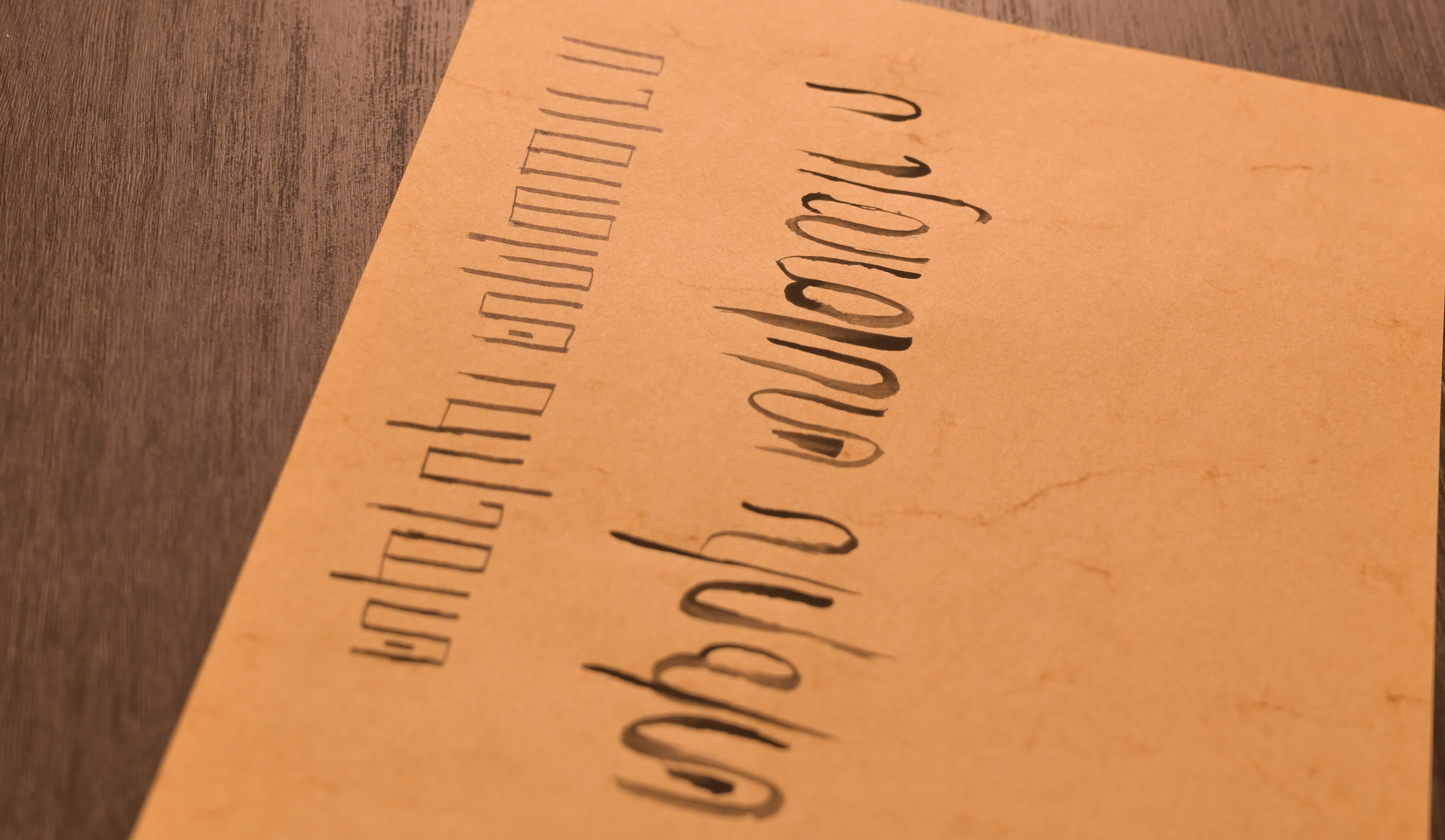
Niyulira, just like any other language officially spoken in the Empire of Niyuvara, is written using the Dravama script, a (mostly) vertical abugida with three primary typefaces:
- Nilagrasa is a more square-y, blocky, monumental font used mainly for carvings in stone and wood, commonly seen in architecture.
- Ravalagrasa is the standard handwritten font, equivalent to cursive, used on paper, and written with styli, brushes, or pencils. Although there indeed is a standardised Ravalagrasa typeface, taught in schools to be used with brushes and styli, the word can more broadly be used to refer to any curvy, flowing handwritten style.
- Amyalagrasa is the font used in the printing press, allowing for more elaborate details, having an aesthetic development similar to gothic typefaces.
Horizontal writing is most commonly used in architraves, and is written from right to left.
Digitally, only Nilagrasa is available as a font yet, so it is the only writing system in which I can currently print texts.
A taste of the language
Here's an example of a sentence, seemingly random, but encompassing several nuances of Niyulira grammar. In the clause with the woman in the agent position, the verb is marked in the experiential, while the same doesn't happen in the second clause, with the speaker as the agent, conveying that while the woman had seen the forest before, the speaker had not. Another feature is the use of coindexation in "yuvyular" in the second clause. If the coindexation suffix weren't present, the forest mentioned would not be the same as the one in the first clause. Besides, while the first clause features no focus, the second does, marking the agent in the absolutive (the pronoun "vam") and the patient in the genitive.
woman=ERG see=EXPR forest=ABS.SG | 1.SG.ABS see forest=GEN.SG=COIX also
A few words
Here are some words with no direct translation in English:
Let's build a language.
I create bespoke constructed languages tailored to fictional worlds, characters, cultures, games, films, and other creative projects.
Commission a language