Suilian
Natively: sɯ̄nıuɥruq · sūljandař [sʉːɮʲɒndɐχ]
About the language
Suilian is the official and most spoken language of Suilia, an intriguing, large insular nation between Tunisia and Malta. It simultaneously keeps its roots as a descendant of Ancient Egyptian, and displays a plethora of unique features originated from mysterious substrates of mainly Uralic, and some Vasconic origins. How Uralic people ended up in an island in the Mediterranean is still a mystery, though it is certain that it left an enormous richness in its contact with the native Afroasiatic features of Suilian. The native non-concatenative morphology is left only vestigially in some derivations.
Suilian is designed as a uniquely peculiar blend of cultures and languages, from the Egyptian roots of its people to the Uralic-based substrates, and the Mesoamerican contact in Suilia's lost colonies. It is distinctive for its split ergativity, deictic precision, verbal modalities, and lack of adjectives.
How it sounds
Suilian balances a smooth, resonant, and vocalic foundation with sharp, rhythmic, and dense consonantal clusters, which I consider gives it a lyrical yet dramatic acoustic profile.
Suilian allophony is richly defined by intervocalic voicing, vocalic reduction in word-final closed syllables, diphthongisation in word-final open syllables, a more or less Albanian-like [ɾ~ɹ] rhotic distinction, word-final stop glottalisation (which in a few rural dialects originates some tonogenesis), heavy palatalisation, velar-to-uvular stop backing when adjacent to [ɒ], among several other phenomena.
Consonants
| Place / Manner | Bilabial | Labiodental | Dental | Alveolar | (Alveolo-)Palatal | Non-Palatal Dorsal | Glottal |
|---|---|---|---|---|---|---|---|
| Nasal | m | — | — | n | — | — | ŋ |
| Plosive | p | — | t̪ | d | — | — | k · g |
| Affricate | — | — | — | dz | tɕ | — | — |
| Fricative | β | f · v | θ · ð | s · z | ɕ | x | h |
| Lateral Fricative | — | — | — | ɮ | — | — | — |
| Approximant | w | — | — | ɾ · ɹ | j | ʀ | — |
Vowels
| Height | Front | Front rounded | Central | Back |
|---|---|---|---|---|
| Close | i · iː | y · yː | ɨ · ʉː | — |
| Mid or Open | æ · ɛː | œ · ɵː | ɒ · äː | o̞ · o̞ː |
Structure & grammar
Word order
Suilian mostly uses a VSO word order as standard, preserving this feature from Ancient Egyptian, unlike Coptic. The rule of placing verbs in an initial position in clauses is practically universally mandatory to all Suilian sentences, though under some circumstances the order of its arguments cam be changed. Nominal forms of verbs, however, behave syntactically as nouns.
Morphology
While historically the base of Suilian morphology, the language's mostly non-concatenative structure has been gradually replaced by agglutinative features and is nowadays rather vestigial and only found fossilised in older words, nowadays considered irregular. Grammatical gender distinctions have also been universally lost.
Nouns
Suilian nouns inflect in number and case, and to them can be added definiteness-marking clitics and possessive suffixes. There is a singular-dual-plural distinction, with distinct forms for the nominative, genitive, ergative, and partitive, and, for each grammatical number, an oblique stem to which other endings of adpositional value can be attached, forming the instructive/instrumental (by means of X), instructive-privative (without using X), comitative (along with X), comitative-privative (without X) benefactive (in favour of X), malefactive (in detriment of X), inessive (in/within/inside X), elative (outwards from X), illative (into X), ectessive (outside of X), adessive (at/on/by X), ablative (from X), allative (to/towards X), immotive (standing in a position unrelated to X), essive (as/in the state of X), delative (out from the state of X), translative (becoming X), and abessive (not in the state of X), noting that some of these cases indeed have meanings completely different from the ones they might have in natlangs that include them. Possessive suffixes are usually added after the case ending, though adding them before this ending is not grammatically incorrect. Definite clitics are highly variable depending on the word's phonology, working similar to those of languages such as Arabic and Maltese: in a general rule, assimilating to the word's initial consonant when it is coronal.
Verbs
Verbs are conjugated by person/number, tense, and mood. There are nine grammatical person-number combinations, each with its ending. There are six tenses, all of which can be conjugated in the nonpast and the past, though the indicative splits the nonpast into present and future, alongside being the only mood compatible with perfect tenses, using the copula "ūnva" as an auxiliary. The imperative is not on the list of primary verbal moods, instead existing as a sole form, with "i-" or "j-" prefixed to the infinitive, and often being grouped alongside nominal forms. Each mood has specific usages:
- The indicative, the only mood with six tenses rather than two, is the most common mood, and the main realis one, used for statements of fact, real-world events, and assertions that the speaker presents as true;
- The terminative signals the absolute endpoint limit, or final completion of an action, focusing the listener's attention strictly on the end of an action. Though this is often conveyed by aspects in most languages with this distinction, Suilian, lacking a system of aspects, grammatically treats it as a mood;
- The subjunctive is the main irrealis mood, used for hypothetical scenarios;
- The consecutive can be either realis or irrealis, and is only used in dependent clauses. When the head clause uses a realis mood, the consecutive presents the factual outcome of the action described. If, on the other hand, the head clause uses an irrealis mood, usually the subjunctive, the consecutive acts as a conditional, "would" mood;
- The obligative expresses strict necessity, duty, or a moral and/or legal obligation. It is distinct from the imperative, since the obligative is much closer to conveying the same as "must" or "have to" convey in English, while the imperative is a bare command, though their semantic roles can often overlap, the obligative being generally considered more polite than the direct nature of the imperative;
- The potential mood presents possible scenarios, equivalent to phrases in English with "can", "may", or "might". Both of its tenses can also replace the role of the indicative in highly polite speech, while the past might replace the role of the obligative and imperative in the same contexts.
Split ergativity
Suilian presents a highly complex alignment based primarily on distinctions in volitionality. In the past, it has been more straightforward, when quirky subjects were applied to the native Nominative-Accusative alignment, turning this into a fluid-S agentive-patientive alignment. This alignment, however, eventually got split up into an unstable four-case system, with the agentive becoming the nominative in volitional clauses and the ergative in non-volitional ones, and the patientive becoming the accusative in volitional clauses and the absolutive in non-volitional ones. Due to this four-way system's imminent instability, the absolutive ended up quickly merging into the nominative, and a case shift associated with quirky subjects bringing the accusative to intransitive non-volitional clauses obfuscated the original paradigm even more. A later merger of the accusative into the genitive lead to what would become the partitive taking the original accusative position in atelic contexts. The modern Suilian alignment system uses:
- The nominative for the sole argument of volitional intransitive clauses, the agent of volitional transitive clauses, and the patient of non-volitional transitive clauses;
- The genitive for the telic patient of volitional transitive clauses, and the telic sole argument of non-volitional intransitive clauses;
- The partitive for the atelic patient of volitional transitive clauses, and the atelic sole argument of non-volitional intransitive clauses;
- The ergative for the agent of non-volitional transitive clauses.
Other features
Non-concatenative morphology is present in old non-concatenative morphology. For example, the Egyptian root √snb (related to health) originated Suilian words such as ”sanavma” (verb, ”to be healthy”) and ”sinø̄” (”health”). This non-concatenative morphology is also present in causative derivations, though unproductive, it nowadays being formed solely by the prefix ”s(V)-”. Most of these examples are of verbs very commonly used throughout the language’s evolution, such as ”mampa” (to be firm) to ”semīmpa” (to establish), and ”mōva” (to die) to ”samaiva” (to kill). Furthermore, the concept of adjectives is mostly absent, the closest equivalent being non-finite forms of verbs, which can be used attributively. Statively, they are treated entirely as verbs. An example of such stative verbs is "krøima" (to be hollow), which is used attributively in the translation of section 05 in its agentive participle form "krøjiri" (as one who is hollow / hollow-being).
The written language
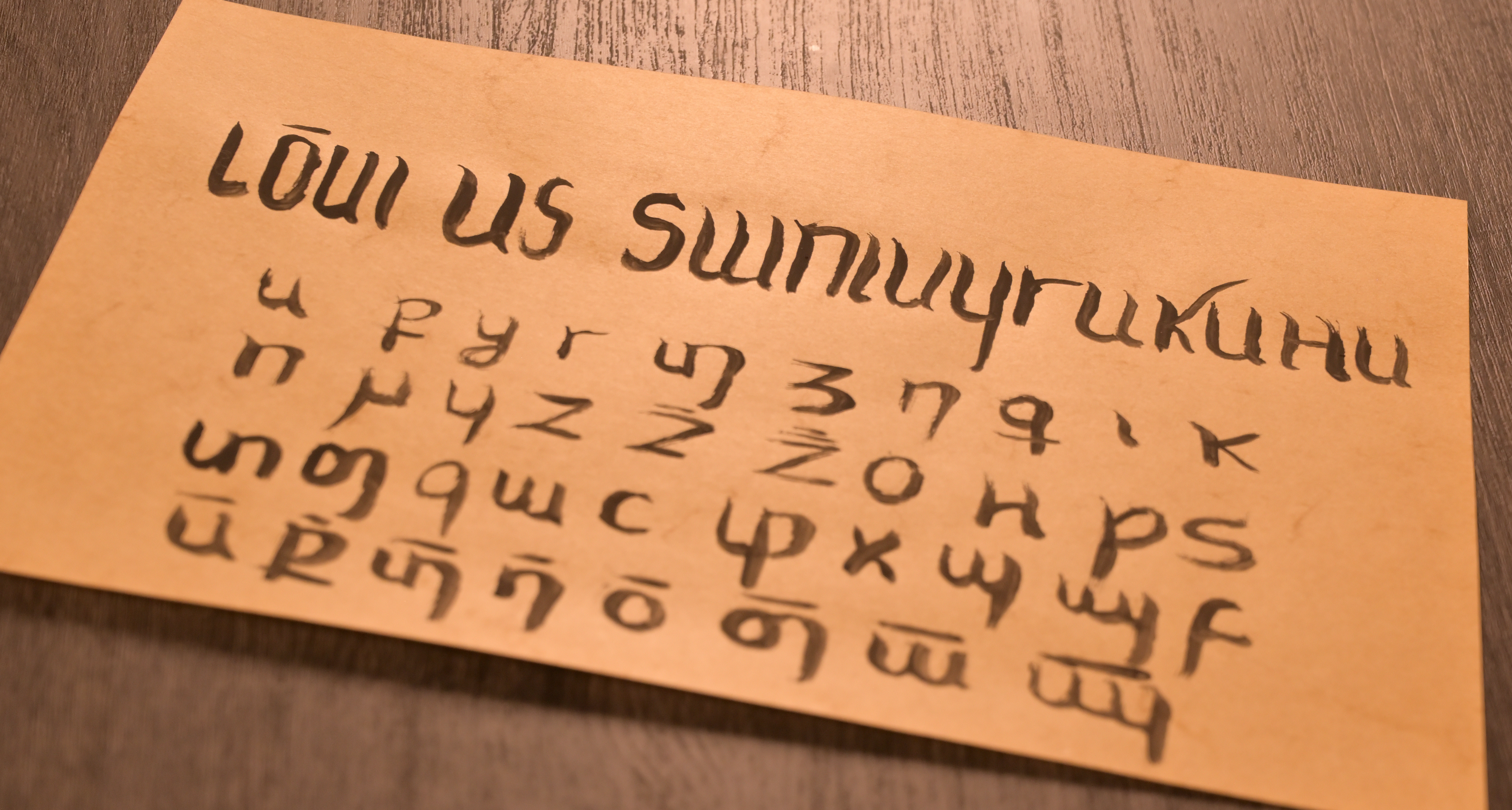
While logographs descended from Egyptian hieroglyphs can sometimes be found on inscriptions in temples, the primary writing system to represent Suilian is the Suilian alphabet, descended from its Greek counterpart, with influences from some other writing systems such as the Latin and Coptic, and not in-universe but with a strong aesthetic inspiration from Armenian and the medieval Georgian alphabet Nuskhuri. The primary writing direction is left-to-right within a line, with lines arranged from top to bottom, though boustrophedon can also (though seldom) be used. It's relatively common for pairs of "doublet letters" to exist, in the sense that a Greek letter originates a Suilian one used for a native sound, and later the same letter is borrowed and used in loanwords from Greek origin. Later, these letters used primarily for Greek loanwords were also often used for loanwords of different origins. The early Suilian script, used for an older form of the language, had very few graphemes to represent vowels, and with later phonological processes, several ligatures were made, which makes vowels rather unrecognisable when compared to Greek counterparts with similar pronunciations.
A taste of the language
be_good=3.SG DEF=everything | speak=3.SG | while=be=INF eyes=PL=3.SG.POSS hole=PL be_hollow=AGENTIVE.PTCP
A few words
Here are some words with no direct translation in English:
Let's build a language.
I create bespoke constructed languages tailored to fictional worlds, characters, cultures, games, films, and other creative projects.
Commission a language