Dusaldir
Natively: dusaldir [t̬ʉzɑllɪɾ]
About the language
In August 2026, I spent a week visiting the areas around Bergen, Norway, having an amazing opportunity to get fascinated by such a beautiful language I had known little about before, Norwegian. This inspired my to create a more Scandinavian-influenced conlang than I usually do. At the time, I was highly invested in the Antichthon project, and thought about fitting that (roughly-)Norwegian-inspired language into the project. That is how Dusaldir started. In-universe, it is spoken in Dimøgrav, the largest overseas territory of Niyuvara. After having developed the technology to build ships advanced enough for deep seafaring, some late Proto-Lyro-Vateotic populations migrated to what would, centuries later, become their "cousins'" (the Niyulira-speaking populations in Niyuvara proper) overseas territory. Although Niyulira and Dusaldir are related, and both even in the Lyraic branch of the family, centuries of complete isolation have made the two languages extremely different. Even after the colonisation of Dimøgrav and subsequent adoption of the Dravama script, Dusaldir evolved so drastically, and so quickly, that predicting most words' pronunciation based solely on spelling is an enormous challenge to non-native speakers, even ones whose native language uses the Dravama script.
My design philosophy for Dusaldir is to avoid an absolutely excessive influence from Norwegian, though making a nod to the language. Dusaldir retains its basis from Proto-Lyro-Vateotic, naturalistically building on it by innovating with its own unique features, not necessarily all Norwegian-influenced. The most notable features of Dusaldir, though, are its extreme historical spelling, its V2-based syntax, deictic system, and semantosyntactic markers.
How it sounds
Dusaldir features a much heavier, consonant-packed aesthetic than most conlangs of mine, giving it a deeply texturally rich sound.
The language's phonemic inventory alone is extremely divergent from what would be usual for a language of the Lyraic branch, featuring a full class of retroflex consonants, and with plosives having a distinction mostly in aspiration rather than voicing, though the unaspirated forms may also be half-voiced. Its vowel inventory is also extremely unconventional for a Lyraic language, considering that Proto-Lyro-Vateotic had an inventory of only four vowels, which was reduced to just three in Proto-Lyraic. In modern Dusaldir, however, phonological processes have expanded this system into a much larger vocalic inventory, with seven distinct short vowels and their long counterparts.
Mostly in coda positions, the historical */g/ sound was lenited to [ɣ], later forming diphthongs with the preceding vowels, these coming as [ɪj, æɪ̯, ɔʏ̯, ɑɪ̯, ʉɪ̯, ʊʏ̯, œɪ̯]. Word-final /æv/ also becomes a diphthong, [æʉ̯].
Aspirated plosives get unaspirated in coda positions and/or before other consonants. Alveolar and dorsal stops are prone to being heavily palatalised whenever preceding [ɪ] or [œ]. Word-initially, any occurrence of [j] is lost before [ɪ] (or its long counterpart), leading to a shift in which word-initial palatalised /t̬/ and /k̬/ are lost, which is the case for the native pronunciation of Dimøgrav, as [ʔɪmœɪ̯ɾɑf], the glottal stop having been inserted later in words with initial vowels.
Word-final phonetic erosion is particularly strong, with /æ/ shifting to [ə] under some specific circumstances, /t̬/ being lost word-finally, and final /-Vɾə/ strings shifting to [-Vː]. This leads to counterintuintive spelling-pronunciation matches, such as the pronunciation of what would be directly romanised as "tjegtired", as [çæɪ̯çiː].
Consonants
| Place / Manner | Labial | Alveolar | Retroflex | Dorsal | Glottal |
|---|---|---|---|---|---|
| Nasal | m | n | — | ŋ | — |
| Plosive | pʰ · p̬ | tʰ · t̬ | ʈʰ · ʈ̬ | kʰ · k̬ | — |
| Fricative | f · v | s | ʂ | ç | h |
| Approximant | — | l | ɭ | j | — |
| Rhotic | — | ɾ | — | — | — |
Vowels
| Historical height | Front | Umlauted | Back |
|---|---|---|---|
| Close | ɪ · iː | ɪ · iː | ʉ · ʉː |
| Close-mid | æ · æː | œ · øː | ʊ · uː |
| Open-mid | — | — | ɔ · oː |
| Open | — | æ · æː | ɑ · ɑː |
Structure & grammar
Word order
Word order in Dusaldir is one of the language's most unique features, as Dusaldir is quite difficult to classify into a standard category, yet it can be more accurately described as primarily V2. More on the word order can be found below.
Morphology
Dusaldir presents a morphology highly divergent from what can be found in other Lyraic langauges.
Nouns and Verbs
Dusaldir inflectional morphology is mostly highly divergent from Proto-Lyro-Vateotic, being one of the few languages in the family that lack a case system, and having innovated definition. It is also the family's only fusional language. It stands, however, as the only language to retain the Proto-Lyro-Vateotic paucal, though only in some rural dialects and/or poetic registers. Nouns are, therefore, inflected in number (singular, plural, and paucal), possession state (absolute or possessed, the latter being used with both nouns or pronouns), and definiteness (definite or indefinite). Similarly to Niyulira, a humble prefix can be added to any noun, usually to convey the referred entity is of high importance when compared to the speaker. Verbs conjugate by tense, mood, experientiality, and polarity. The tenses are the present, past, and (arguably) future. The past tense is formed by a series of non-concatenative ablaut rules in the first syllable which, due to the deeply complex sound changes that occurred in Dusaldir, are hardly predictable. The future, on the other hand, is formed with the auxiliary verb "sjela", from Proto-Lyro-Vateotic *χʲil-. Experienciality and negative polarity are conjugated directly into the verb, while the interrogative forms are conveyed by a clitic. There are three moods, these being the realis, irrealis, and imperative, the latter of which fully lacking experientiality distinctions and the past tense, and being incompatible with the interrogative clitic.
Deixis
Dusaldir has a system of deictic markers which, in reality, arose as the most naturalistic response to my urge to include the two features below (V2 word order and semantosyntactic markers) in the language. There are precisely ninety different markers, formed from combining one of ten spatial components with one of nine temporal-dimensional components. The spatial components are "nirt-" (here, proximal), "dita-" (there, medial), "lag-" (there, distal), "itlog" (elsewhere), "mli-" (somewhere), "lavag-" (in front), "jå-" (to the back), "vohåg-" (above), "vart-" (below), and "tlu-" (everywhere), while the temporal-dimensional components are "-tjamus" (now, proximal), "-nil" (then, distal, either past or future), "-indil" (not now), "-mel" (sometime, indefinite), "-sæ" (before, past), "-nasel" (after, future), "-tel" (everytime), "-nus" (in a dimention above), and "-læglikro" (in a dimension below), the last two being solely used metaphorically to convey irrealis or something similar to an indirect evidentiality. While, in English, these markings are completely optional, in Dusaldir, they are much more commonly used and, even if not strictly mandatory, represent a central part of Dusaldir clauses, especially in afocal ones (more on that below, under "word order")
Word Order
Dusaldir word order is primarily V2, though, very similarly to German, this shifts to V1 in interrogative questions, and often verb-final in dependent clauses. The position of the remaining arguments varies depending on three variables: valency (avalent/monovalent/bivalent/trivalent), "deicticity" (deictic/adeictic), and focus (afocal/subject/direct/indirect). Valency refers to the number of arguments a verb requires, so an avalent verb requires no arguments (equivalent to English "to rain", though English still requires a dummy subject), while monovalent (aka intransitive, as "to sleep"), bivalent (aka transitive, as "to throw"), and trivalent (aka bitransitive, as "to give") verbs have more complex rules on their clauses' word order. Deicticity, a term I coined specifically to describe this Dusaldir feature, refers to whether or not the clause includes a deictic marker. Focus refers to whether the clause has a primary focus point (more relevant information the speaker intends to emphasise, which in Dusaldir can be a subject, direct object, or indirect object) or, and as in most sentences, that focus is absent, those sentences being referred to as afocal. Here are all the rules for word orders for non-interrogative head clauses, with "S" for the subject, "O" for the object in a bivalent clause, "D" for the direct object in a trivalent one, "I" for the indirect object in the same context, "X" for the deictic marker, and "m" for the semantosyntactic marker.
- In avalent clauses, the word order is XV if deictic, V if adeictic. In a similarly simple way, in monovalent clauses, the word order is XVS if deictic afocal, SVX if deictic and subject-focal, and SV if adeictic.
- Deictic afocal clauses require the deictic marker to come at the beginning of the sentence, creating an XV- structure. Any focused argument takes the place of this deictic marker, either turning the sentence tendentially adeictic, or moving the marker to another part of the sentence.
- Adeictic afocal clauses place the subject in the beginning if bivalent, forming an SVmO structure, and the indirect object if trivalent, forming IVSmD. With subject focus, this focus is conveyed by intonation.
- Afocal clauses have strict word orders for what comes after the verb, it being (S)mO if bivalent, the S being absent there and present in the beginning of the clause if it is adeictic; and SmD(I) if trivalent, the I moving to the beginning of an adeictic clause.
- In deictic focal clauses, when bivalent or trivalent, word order is more flexible, depending mostly on the sentence's components' length.
Semantosyntactic Markers
Semantosyntactic markers are a feature of bivalent and trivalent clauses. There are three semantosyntactic markers, which I will refer to as personal, impersonal, and conceptual, though the names are, rather than originally mine, adapted from a similar concept I once found online. In a sentence such as "I saw a person there", English does not mandate the speaker to specify the syntactic relationship between themself and the person they are referring to. Dusaldir, on the other hand, not just distinguishes between whether or not the speaker had already seen the person before (through experientiality), as it also forces them to make a second distinction between "Lægnil sibid vo un har" and "Lægnil sibid vo i har" ("lægnil" is a deictic marker, "sibid" is the verb for "to see" in the past experiential affirmative realis), the former, having a personal marker, implying that the entities referred to by the arguments are established acquaintances, while the second, using an impersonal marker, conveys otherwise. Another considerable example could be "Nirtjamus advid vo i lurdynar" (I want some kumquats, "nirtjamus" being a deictic marker, "advid" being the present experiential affirmative realis of "to want", "lurdynar" being the plural of "lurdyn", "kumquat"), where the impersonal "i" is used, the alternative being the conceptual "me". If the sentence used "me", the kumquats would be merely a fruit of the speaker's conceptualisation, while "i" implies the speaker has seen some kumquats before using the sentence. As long as one of the arguments is of inanimate semantic value, the personal semantosyntactic marker cannot be used.
The written language
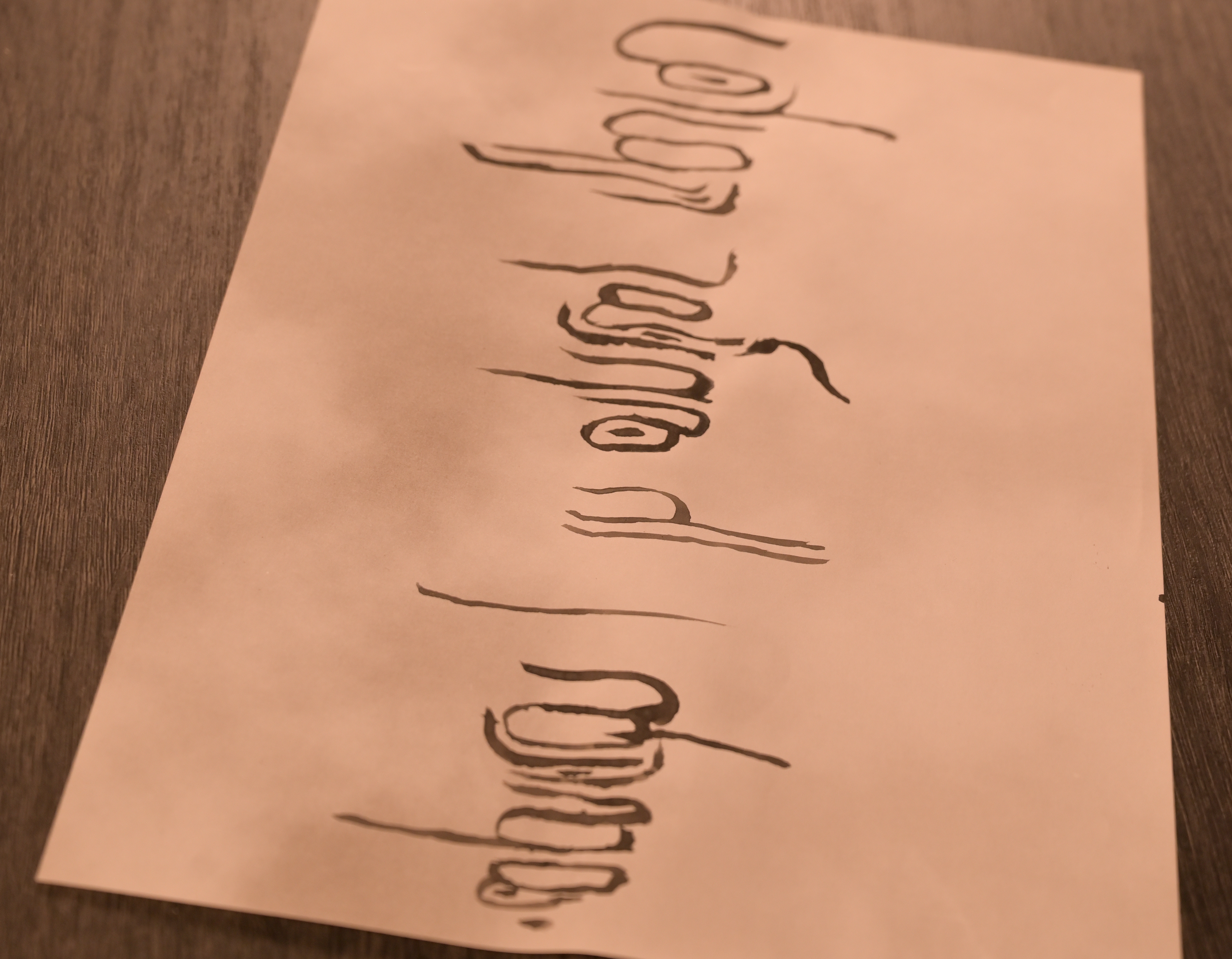
Dusaldir uses the Dravama script, adopted from Niyulira, and uses the same three typefaces. The Niyulira page has more information on it.
A taste of the language
UNIV=UNIV.TEMP speak=EXPR 1.SG IPERS Dusaldir
A few words
Here are some words with no direct translation in English:
Let's build a language.
I create bespoke constructed languages tailored to fictional worlds, characters, cultures, games, films, and other creative projects.
Commission a language